How to Sell Digital Products Online in 2026: The Step-by-Step Guide
Reading Time
10
Published On
Updated On

Brian Moran
Founder

Samara Lemon
VP of Marketing

Leilani Treuting
Marketing Director

Scott Moran
Co-Founder

SamCart is the digital business platform that builds, runs, and scales your online business. AI handles the hard parts, so you keep more of what you earn.
Table of Contents
Title
Share this article
Why Most People Lose Money Selling Digital Products Online
There are a lot of people online making great money teaching you the wrong way to sell digital products.
The biggest misconception: that digital products are a one-size-fits-all game.
Some people tell you to create a $500 course and pray enough people buy it to quit your job. Others tell you to create $10 templates on Etsy and make it up on volume. Both are losing strategies. The first leaves you with no customers. The second leaves you with customers who don't trust you enough to buy anything else.
SamCart's million-dollar brands don't do either.
After processing more than $7 billion in sales across 75,000+ businesses, we can see exactly what the winners do that the losers don't. The answer isn't a better product. It's a better business model.
If you're brand new and still figuring out what to sell, start with our guide to what a digital product is and how to create one. If you already know what you want to sell, keep reading.
🔑 Key Takeaways
• Only 12% of customers ever buy from you twice, but that 12% accounts for 46% of revenue
• The highest-converting first-date offers are priced between $20 and $100
• Sellers who use order bumps and upsells make 7x more than sellers who don't
• 30-40% of customers add order bumps when offered
• The biggest digital product brands are hybrid businesses that expanded into services, events, and physical goods
The 3-Step Business Model SamCart's Top Sellers Use
There are only three ways to grow any business:
Growth Lever | What It Looks Like | Where the Money Is |
|---|---|---|
More customers | Inexpensive first-date offers ($20-$100) | Customer acquisition |
Spending more | Order bumps, upsells, upgrades | Day-one profit |
Coming back more often | New products, workshops, coaching, events | Long-term revenue |
That's the whole playbook. The rest of this guide is how to execute each one.
Step 1: The First-Date Offer (How to Get More Customers)
If you want more customers in the door, you don't start by trying to sell them a $500 course. You start with something cheaper and easier to say yes to.
Think of it like a first date. You wouldn't propose marriage on a first date. You'd grab coffee. Low-risk, low-commitment, see if there's a fit.
That's what the best digital product businesses do. They create a quick, genuinely useful digital product and price it between $20 and $100.
Why $20 to $100 Is the Sweet Spot
SamCart's Creator Profit Report analyzed top-selling digital products across every major niche. The data is remarkably consistent:
Writing: $27-$97 dominates
Sports and fitness: $47-$100 dominates
Business and marketing: $47-$97 dominates
Parenting: $17-$67 dominates
Finance and investing: $47-$100 dominates
The most popular first-date offer in almost every niche lands under $100. Not because top sellers couldn't charge more. Because they understand the goal of the first sale.
The goal of the first sale isn't profit. It's a customer.
Once someone has your product in their hands and their credit card on file, everything else in your business gets easier. You have a name on your list. A buyer, not a lurker. Someone who has already decided to trust you.
What Makes a Great First-Date Offer
A first-date offer should do three things:
Solve one specific problem fast. Not "everything you need to know." Just one pain point, solved.
Be consumable in under an hour. A 45-minute audio training beats a 12-module course for a first purchase.
Set up the next offer naturally. The best first-date offers leave the buyer wanting more of a specific thing you already sell.
Some proven first-date formats: short ebooks (see how to sell an ebook for the full playbook), templates and swipe files (how to sell templates online), mini-courses, workbooks, challenges, and audio trainings.
The Secret Advantage of Digital Products
Digital products cost you almost nothing to make and can be produced in days. That makes them the single best customer acquisition tool on the planet. Even for businesses whose main offer isn't digital.
A fishing brand can sell a digital newsletter to acquire customers for a physical tackle line. A coach can sell a $27 guide to acquire customers for a $5,000 program. A fitness creator can sell a $19 workout plan to acquire customers for supplements and equipment.
The digital product doesn't have to be the profit center. It just has to be the engine that fills your list.
Step 2: Expansion Revenue (How to 3x the Value of Every Customer)
Getting more customers is step one. But the first date is just the beginning.
Step two is helping every customer spend more while they are already buying.
Million-dollar brands never let a customer buy just one thing. They give every buyer a chance to add, upgrade, and expand in the moment when buying mode is already activated.
The Three Expansion Revenue Tools
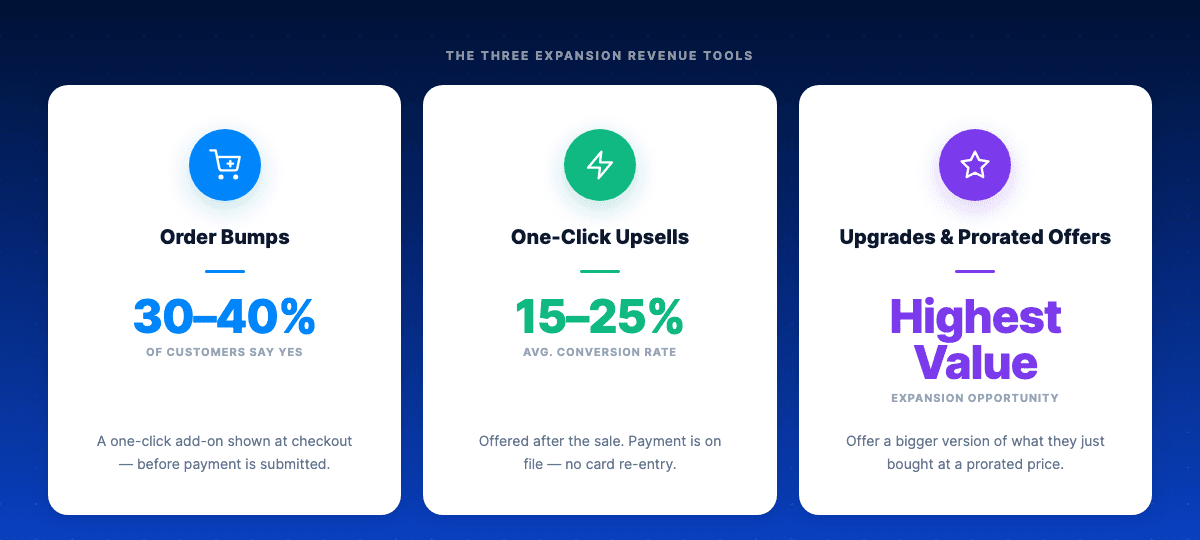
Order bumps. A one-click add-on offered during the sale. "Want to add a 90-day meal plan for $49?" SamCart data shows 30 to 40 percent of customers say yes.
One-click upsells. An upgrade offered after the order is submitted. Payment info is already on file. One click, one charge, no re-entering a card number. Conversion rates typically run 15-25%.
Upgrades and prorated offers. The highest-value expansion: offering a bigger version of the product the customer just bought at a prorated price. "You just bought the $15 guide. Upgrade to the full $199 video course for $184, today only."
For a deeper dive on how to structure these, see our full guide on upselling strategies that work.
Why This Works: The Average Order Value Math
Look at the sports niche in SamCart's data. The most popular first-date offer is around $100. But top sellers in that niche are collecting $250 in average order value.
That's 2.5x more revenue on the same traffic. Same ad spend. Same customer. Completely different business.
Across our entire database, sellers who use order bumps, upsells, and upgrades make 7 times more than sellers who don't.
Read that number again. 7x.
It's why Amazon shows you recommended products in every cart. It's why Apple lets you upgrade your phone's storage and add AppleCare. Those aren't features. Those are the entire business model.
A Real Expansion Revenue Example
Let's make this concrete with a fitness example. You're a personal trainer launching a digital product business.
Front-end offer: A $15 90-day workout guide. Low-risk, high-value, easy yes.
Order bump #1: A 90-day meal plan for $49. 35% of customers add it.
Order bump #2: A pack of AI prompts that generate custom fitness routines for $20. 25% of customers add it.
Upsell: Your full video course. Normally $199, available now for $184 (prorated). 20% take it.
High-ticket upgrade: A 1-on-1 consultation to build a custom plan for $100. 20% take it.
Stage | Take Rate | Revenue Per 100 Buyers |
|---|---|---|
Front-end ($15) | 100% | $1,500 |
Meal plan bump ($49) | 35% | $1,715 |
AI prompts bump ($20) | 25% | $500 |
Video course upsell ($184) | 20% | $3,680 |
1-on-1 consultation ($100) | 20% | $2,000 |
TOTAL per 100 buyers | $9,395 | |
Average order value | $93.95 |
Your $15 front-end is really a $94 front-end. Same traffic. Same ad spend. Completely different business.
Step 3: Repeat Customers (Where the Real Money Is)
Only 12% of customers ever buy from you twice. But that 12% drives 46% of your total revenue.
Read that one more time. Twelve percent of your customers account for almost half your money and almost all of your profit.
Which means step three, bringing customers back, is mathematically the most important lever in your entire business.
What "Bringing Them Back" Actually Looks Like
Quarterly product launches. A new digital product every three months keeps your list warm and re-engaged.
Live workshops and events. Running a paid workshop to your buyer list converts 5-10x better than to a cold audience.
Service or coaching offers. The highest-ticket offer should be reserved for people who have already bought from you.
Seasonal sales. Black Friday, New Year, back-to-school. Real deadlines drive real purchases.
Certifications and advanced programs. Once someone has completed your starter product, they are the most likely buyer for your advanced one.
A Real Hybrid Business Example
A SamCart seller named Nick Wolny sold inexpensive digital products as a first date, then fed buyers over to his writing agency, which charged $5,000 per month for services. The digital products weren't the money. They were the customer acquisition engine that fed the back end.
The Hybrid Business Playbook (Why Most Top Sellers Aren't Pure Digital)
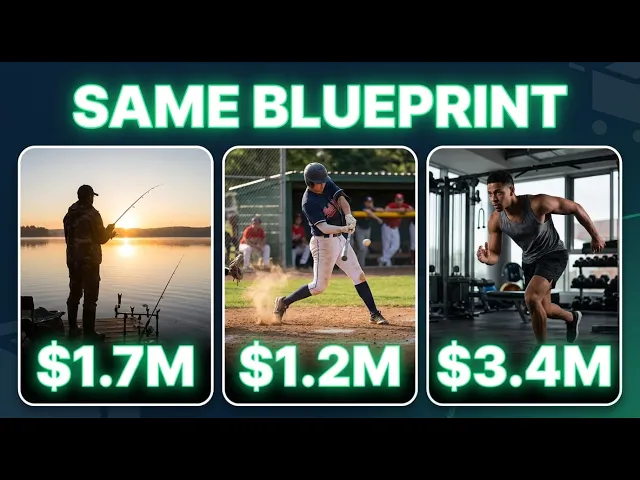
The majority of SamCart's million-dollar brands aren't pure digital product businesses. They are hybrid businesses that started with digital products and expanded into whatever their audience needed next.
Brand Type | First-Date Offer | Back-End |
|---|---|---|
Fishing brand | Digital newsletter ($14/mo) | Lures, apparel, fishing rods |
Fitness brand | 30-day workshop ($47) | Supplements, equipment, coaching |
Baseball training | Digital warm-up routine ($27) | 1-on-1 coaching services |
Personal finance | Budget template ($19) | Group coaching, certifications |
Business coach | Sales script pack ($37) | $10K mastermind |
The front-end is always digital. The back-end is whatever the audience actually needs.
Own Your Customers (Or Someone Else Will)
You have to own your customers.
When someone buys from you on a marketplace, who owns the customer data? The marketplace does. You don't get the email address. You don't get the phone number. You can't follow up. You can't sell them your coaching program next month.
You're building someone else's business with every single sale.
Direct vs. Marketplace: The Real Comparison
What You Get | Selling Direct | Selling on a Marketplace |
|---|---|---|
Customer email address | ✅ Yours | ❌ Theirs |
Ability to remarket | ✅ Yes | ❌ No |
Full sale price | ✅ Yes | ❌ No (5-50% fees) |
Order bumps and upsells | ✅ Yes | ❌ Limited |
Protection from policy changes | ✅ Yes | ❌ No |
Brand equity | ✅ You build it | ❌ They build it |
Run ads to buyers | ✅ Yes | ❌ No |
That customer list is the most valuable asset in your entire business. More valuable than your social media followers. More valuable than your content library.
How to Start Selling Digital Products Online This Week
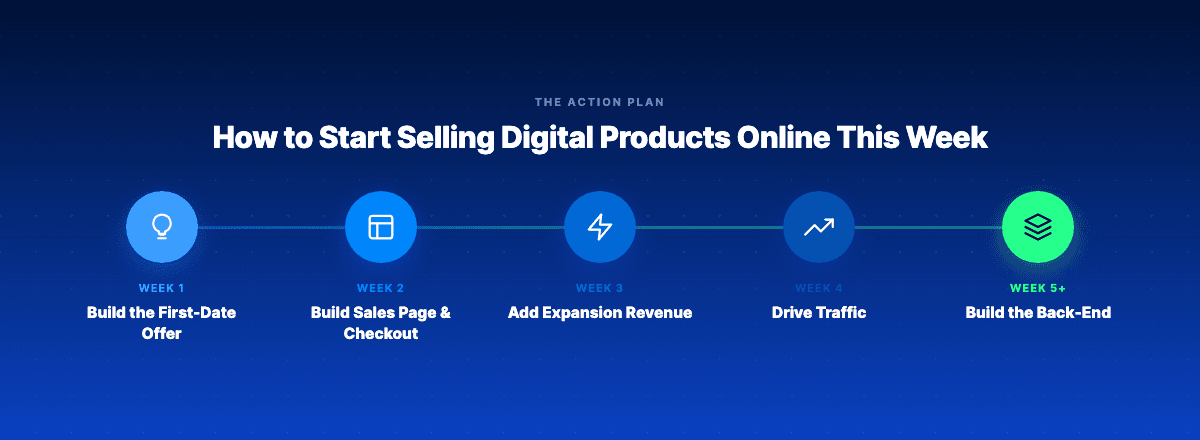
Week 1: Build the first-date offer. Pick one specific problem. Build the smallest possible product that solves it. Price between $20 and $100.
Week 2: Build the sales page and checkout. Specific-outcome headline, problem statement, proof, what's inside, testimonials, direct CTA.
Week 3: Add your expansion revenue. One order bump. One upsell. One of each will triple your economics.
Week 4: Drive traffic. Start with the audience you already have. Paid traffic comes after you prove the offer converts.
Weeks 5+: Build the back-end. New products, deeper programs, services, events. The repeat-customer economy is where the real money is.
How SamCart Runs This Entire Model for You
Today, SamCart's AI builds all of it for you. AI writes your sales page and designs it simultaneously, based on what converts across $7B in real sales. You describe what you want to sell. SamCart builds the rest.
It's trained on 75,000+ businesses and $7 billion in real transactions, which is kind of like hiring the best growth operators in the world to run your business for you.
Related Reading
SamCart Editorial Team
Brian Moran
Founder
Samara Lemon
VP of Marketing
Leilani Treuting
Marketing Director
Scott Moran
Co-Founder
Frequently Asked Questions
Frequently Asked Questions
How do I start selling digital products online?
Start with one inexpensive product priced between $20 and $100. The goal of your first product isn't revenue, it's customer acquisition. Build it fast, put it on a sales page, and get it in front of the audience you already have.
What's the best digital product business model?
The model SamCart's top sellers use: an inexpensive first-date offer to bring customers in, order bumps and upsells during the sale to increase AOV, and additional offers over time to turn buyers into repeat buyers. More customers, spending more, more often.
How much should I charge for my first digital product?
Between $20 and $100 for most niches. SamCart's Creator Profit Report shows this range is where first-date offers convert best across fitness, business education, finance, writing, parenting, and more.
Do I need an audience before I sell digital products?
No, but it helps. The model works for creators with an existing audience (warm traffic) and for sellers starting from scratch (paid traffic, money back on expansion revenue). SamCart's top sellers include both.
What are the best digital products to sell online?
Short ebooks, templates and swipe files, mini-courses (under 2 hours), workbooks and planners, AI prompt packs, and audio trainings. All solve one specific problem and consume in under an hour.
What's the difference between selling on my own platform vs. a marketplace?
Ownership. On a marketplace, the platform owns the customer and takes a commission. You can't follow up or sell them your next product. Selling direct means every customer is yours, every dollar is yours, and every follow-up is possible.
How much money can you make selling digital products online?
SamCart's top digital product sellers do 7 to 9 figures in annual revenue. The difference between $500/month and $50,000/month is almost never the product. It's the model: first-date offers, expansion revenue, and repeat customers.
How long does it take to start making money selling digital products?
Most SamCart sellers generate their first sale within 30 days of launching a first-date offer, assuming they have an existing audience. Without one, 60-90 days while you build traffic.